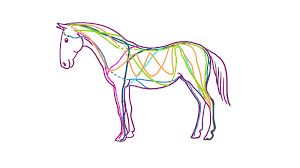
What fascial lines are
Fascia is a continuous web of connective tissue that wraps every muscle, tendon, ligament and organ. Fascial lines are pathways of tension that connect distant parts of the body. When one area gets tight, the entire line is affected.
These lines explain why a poll restriction can show up as a shortened hind stride or why ribcage tension can make a horse drift through one shoulder.
Key fascial lines in the horse
Superficial Dorsal Line
Runs along the topline. Affects neck, back, SI and hamstrings. Tightness here creates hollow posture, shortened stride and topline stiffness.
Superficial Ventral Line
Runs under the body. Supports core engagement. Weakness here leads to dropped sternum and poor lift.
Lateral Line
Runs down both sides. Affects bend, ribcage rotation and lateral softness. When restricted, horses bend one direction but resist the other.
Spiral Line
Connects the body diagonally. Important for balance, transitions and rider influence. Restrictions create crookedness and uneven rein contact.
Front Functional Line
Influences shoulder freedom and forelimb reach. Tightness creates short strides and heavy contact.
Why fascial lines get restricted
- Repetitive strain
- Rider imbalance
- Saddle pressure
- Conformation
- Injury
- Lack of variety in movement
- Stiff footing or deep footing
The body changes based on what it repeats.
How bodywork supports the lines
- Releases tension along entire pathways
- Improves posture and balance
- Restores natural motion
- Reduces uneven loading on joints
- Helps the horse move more fluidly
When the lines soften, the horse feels more “together.
Bottom line
Fascial lines explain the whole-horse picture. They help us find the root cause instead of chasing symptoms.